

Maria Montessori spent decades promoting the cause of the young child and defining the field of child development for future generations. She said:
“Normalization is the single most important result of our work.”
“The first essential for the child’s development is concentration. The child who concentrates is immensely happy.”
Coming from a true genius, these are important statements. But what is Normalization; why is concentration so important, and how can exploring these concepts help parents working with their children at home?
In early childhood we develop a sense of self; and then self-control. Young children learn who they are by acquiring a set of experiences that are theirs. Then they learn how to act purposefully, control their bodies, and follow the accepted rules for behavior in the time and culture of their birth.
 Neuroscience has shown that we are constantly bombarded with literally millions of sensory bits of information. Amazingly, the way we experience the world is actually what is left after we discard most of them. The early years of life are when we learn to focus on the sensory stimuli and behaviors that make us members of our society.
Concentration and focusing attention are essential in this process. Attention is a powerful force. It focuses the human will and concentrates mental energy like a laser. Until a child learns to focus her attention, her mind is a fluctuating field of sensory inputs, emotions, random thoughts, desires, impulses, and dreams. Attention is the force that, when brought under the control of will, allows all that activity to organize itself.
As with almost everything else, the first six years of life are the most powerful time for developing concentration and attention. Whatever is done during these years becomes fundamental to a child’s brain and personality. After that it’s icing on the cake.
 Montessori put her observations of children into practice by giving them special materials she designed, like the Knobbed Cylinders, Pink Tower, Red Rods, Brown Stair, and other Sensorial materials. Almost immediately, she knew she had hit on something important. Very young children started working with these materials with a level of concentration and extended attention span that had not been seen in children before. Two year olds used the materials with total concentration for extended periods, even when Montessori purposely created distractions in the environment.
Photo: The Education of Ours
Montessori believed that children are born with a strong inner drive to learn; and an internal guidance system that leads them to the experiences they need to fully develop. Since the children took to her materials so readily, she assumed the materials were filling a developmental need. She kept creating more; and then designed the Prepared Environment to hold them all and give children a special place to use them. The rest is history.
You can follow Montessori’s lead at home and help your child develop concentration and attention. Since young children are designed to need concrete, hands-on experiences, this means providing materials and activities appropriate to your child’s age and interests. Here is a good guideline:
Provide different materials and experiences, always looking for those that attract and hold your child’s attention.
Let your child use these as often as he likes, with opportunities for uninterrupted repetition.
When your child masters an activity or skill, provide something a bit more challenging or complex.
When your child gradually learns to focus attention and concentrate, you should see positive changes in her behavior. Young children who learn to concentrate become happier and more satisfied with life. This is what Montessori called Normalization. She identified these characteristics of a normalized child:
Love of work
Concentration
Self-discipline
Sociability.
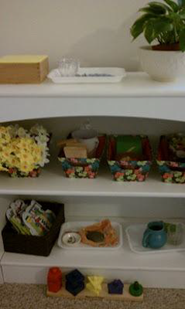 Early learning materials and life experiences that attract and hold your child’s attention are the key to Normalization. Watch for what your child really gets into and make it available. When your child’s interests change, and they will, go with the flow. This is where low shelves that display a variety of materials can be valuable. They allow a child to choose based on his interests on any given day. It will become apparent when a material has outlived its usefulness and you can switch it out for something your child is currently into.
With enough opportunities to learn to concentrate with focused attention, your child’s ability to learn anything will soar. This is why children in Montessori schools typically learn to read, write, use numbers, and understand scientific concepts early on. A child who learns to concentrate is not only happier; he is much better prepared for life. Photo: The Education of Ours
For more on these topics, check out these resources:
- michaelolaf.net
- The Seven Characteristics of a Normalized Child
- Blog post at Montessori Print Shop
- Blog post at Montessori for Everyone
John Bowman is the author of Montessori At Home! and Help Your Preschooler Build a Better Brain.
Email: [email protected].
© 2012 John Bowman, Montessori At Home!
My thanks to John for writing this extensive article for us here at 1+1+1=1! I invite you to ask him any questions you may have in the comments below and he can hopefully answer them for you. If you have an article you hope he will write for us in the future, please let us know in the comments also! Be sure to let him know if this article was helpful-we all love encouragement, right?
You can also visit his new amazing website to read even more!
Did you miss earlier Montessori Minute Posts?
- Introducing Montessori Minute
- Where Do I Start?
- Sensory Activities
- Understanding Dr. Maria Montessori
- A Preschoolers Guide to Home Improvement
- The Three Part Lesson
- What is Montessori?
- Developing a Positive Self Image
- Q & A with John Bowman {answers to questions left on the Sensory Activities post}
Check out our feature on Totally Tots, where Jodi is blogging her experiences while using Montessori At Home! with her young tots!